Payday Super Is Here
5 Steps Every Small Business Owner Must Take Right Now
Sade Norris
7/20/20264 min read

As of July 1, 2026, the way small businesses in Australia handle retirement savings has changed forever. The days of "set and forget" quarterly superannuation payments are officially behind us. Under the new Payday Super legislation, you are now required to pay your employees' superannuation at the same time you pay their wages.
For many SME owners, this is the biggest administrative shift since the introduction of Single Touch Payroll (STP). The goal is simple: to ensure employees receive their entitlements faster and to close the $3.4 billion "super gap." However, for a busy business owner, it means more frequent reporting, tighter deadlines, and a complete rethink of cash flow management.
If you haven't fully adjusted your processes yet, don't panic: but do act. At Figure Fixer, we’ve seen how these changes can catch even the most organised business owners off guard. Here are the five essential steps you must take right now to stay compliant and avoid ATO penalties.
1. Audit Your Pay Cycle and the "7-Day Rule"
The core of the new legislation is the timing. Super contributions must now be received by the employee’s super fund within 7 business days of their payday (known as the Qualifying Earnings day).
This is a significant tightening of the rules. Previously, you had weeks after the end of a quarter to make payments. Now, the clock starts the moment you hit "send" on your payroll.
What you need to do:
Map your process: Document exactly when you run payroll, when the money leaves your bank, and how long it takes to reach the fund.
Buffer for delays: Remember that "received by the fund" is the metric, not "sent by the employer." If your current payment method takes four days to clear, you only have a three-day window to initiate the transfer.
Identify bottlenecks: Are you waiting on manual approvals or paper timesheets? These delays are now compliance risks.
Our payroll services for small business can help you map out a schedule that ensures you never miss that 7-day window.
2. Upgrade and Configure Your Payroll Software
Your software is your first line of defence. To handle Payday Super, your system must be able to calculate Super Guarantee (SG) on "qualifying earnings" for every single pay run and report that data via STP Phase 3.
Most major providers like Xero, MYOB, and QuickBooks have rolled out updates to support these changes, but they aren't always automatic. You may need to manually "opt-in" or adjust your pay templates.
Key software checks:
SuperStream 3.0: Ensure your software supports the latest SuperStream standards required for payday reporting.
Qualifying Earnings (QE): The definition of what attracts super has been refined. Your software needs to include commissions, salary sacrifice, and ordinary time earnings correctly in every run.
SSID Registration: Double-check that your Software Service ID is correctly linked with the ATO.
If you’re unsure if your settings are correct, our small business bookkeeping experts can perform a software health check to ensure your automation is working for you, not against you.
3. Replace the Small Business Superannuation Clearing House (SBSCH)
This is a critical point that many have missed: The ATO’s Small Business Superannuation Clearing House officially closed on 30 June 2026.
If you were one of the thousands of Australian businesses relying on the SBSCH to distribute your quarterly payments, you must find a new solution immediately. The ATO retired the service because it wasn't built to handle the high-frequency, high-speed demands of Payday Super.
Your alternatives include:
Integrated Payroll Payments: Using the built-in "Auto-Super" features in your accounting software (the most efficient method).
Commercial Clearing Houses: Third-party services designed for higher volumes.
Super Fund Portals: Directly paying into an employee’s chosen fund (only viable if you have very few employees all in the same fund).
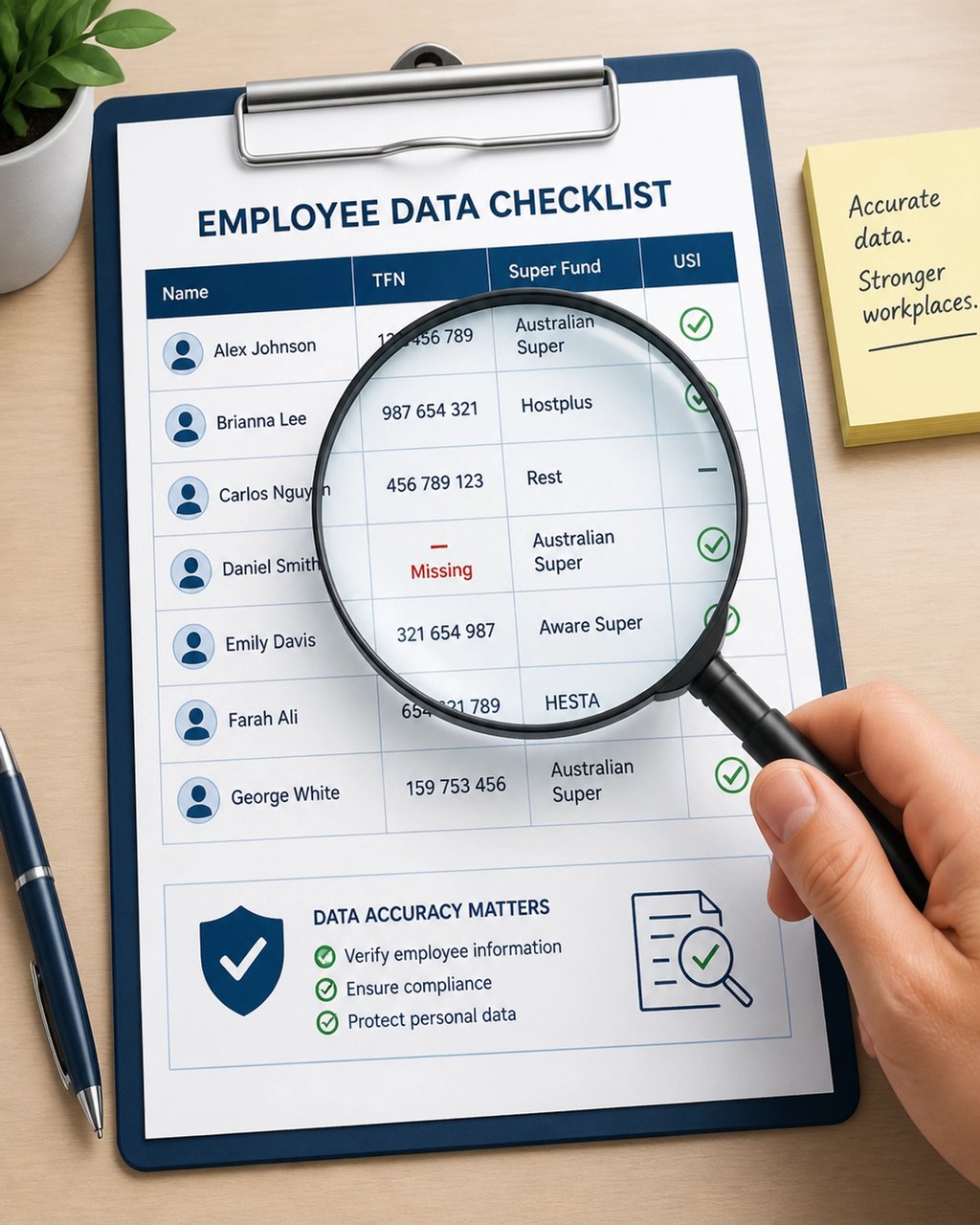
4. The "Deep Clean" of Employee Data
Under the old quarterly system, if a super payment bounced back because of an incorrect member number, you had time to fix it before the deadline. With Payday Super, a rejected payment almost guarantees a late-payment penalty.
Accuracy is now a non-negotiable part of compliance. You have 20 business days to get the first payment right for a new employee, but for existing staff, there is no grace period for errors.
The Data Cleanup Checklist:
Verify TFNs: Ensure all Tax File Numbers are recorded correctly.
Update USIs: Super funds frequently merge or change their Unique Superannuation Identifiers. Check that your records match the current Super Fund Lookup.
Member Numbers: Contact employees to confirm their membership numbers are active.
Standardise Onboarding: Use digital onboarding tools to ensure new employees provide correct super details from day one.
5. Re-Forecast Your Cash Flow Rhythm
Perhaps the biggest challenge of Payday Super isn't the paperwork: it's the bank balance. Moving from one large payment every three months to 26 (fortnightly) or 52 (weekly) payments a year changes your cash flow "pulse."
While it prevents that "bill shock" at the end of the quarter, it means your weekly or fortnightly operating costs just increased by roughly 11.5% (the current SG rate).
How to adjust:
Update your forecasts: Your cash flow projections should now show super as a recurring expense alongside net wages.
Review payment terms: If you have thin margins, you may need to tighten your accounts receivable to ensure the cash is in your account on payday.
Separate accounts: Consider setting up a dedicated "Tax and Super" offset account where you transfer the gross wage cost (including super) each week, ensuring the money is ready for the 7-day clearing window.
How Figure Fixer Can Help
Navigating the transition to Payday Super can feel overwhelming, especially when you're busy running the day-to-day operations of your business. At Figure Fixer, we specialise in helping Australian SMEs bridge the gap between "getting by" and "total compliance."
Our bookkeeping services Australia-wide are designed to take the stress out of payroll. As registered BAS agent services providers, we don't just crunch numbers; we ensure your business meets its legal obligations under the new 2026 rules.
Don't wait for an ATO audit to find out your processes are outdated.
Whether you need a one-off audit of your Xero or MYOB setup or ongoing payroll support, we’re here to help you fix your figures and focus on your growth.
[Contact Figure Fixer today for a Payday Super Readiness Review.]
Figure Fixer
No nonsense bookkeeping for Australian Businesses. No jargon, no judgment.
© 2026 Figure Fixer - Bookkeeping & Financial Clarity
Your Figures, Fixed